
Most community lakes and lagoons across the UAE are not filled from a natural source. They are kept topped up with recycled water, known in the industry as treated sewage effluent or TSE, delivered through the same purple pipe network that irrigates the country’s parks and verges. Using TSE is a sound, sustainable choice that saves scarce desalinated water and reduces cost. It also carries a hidden charge that rarely appears in the handover file: the residual nitrogen and phosphorus that quietly fertilise your water body. In a standing ornamental lake those nutrients feed algae, weeds and sludge, and the cost lands on the facilities budget. This article explains the risk and how to manage it.
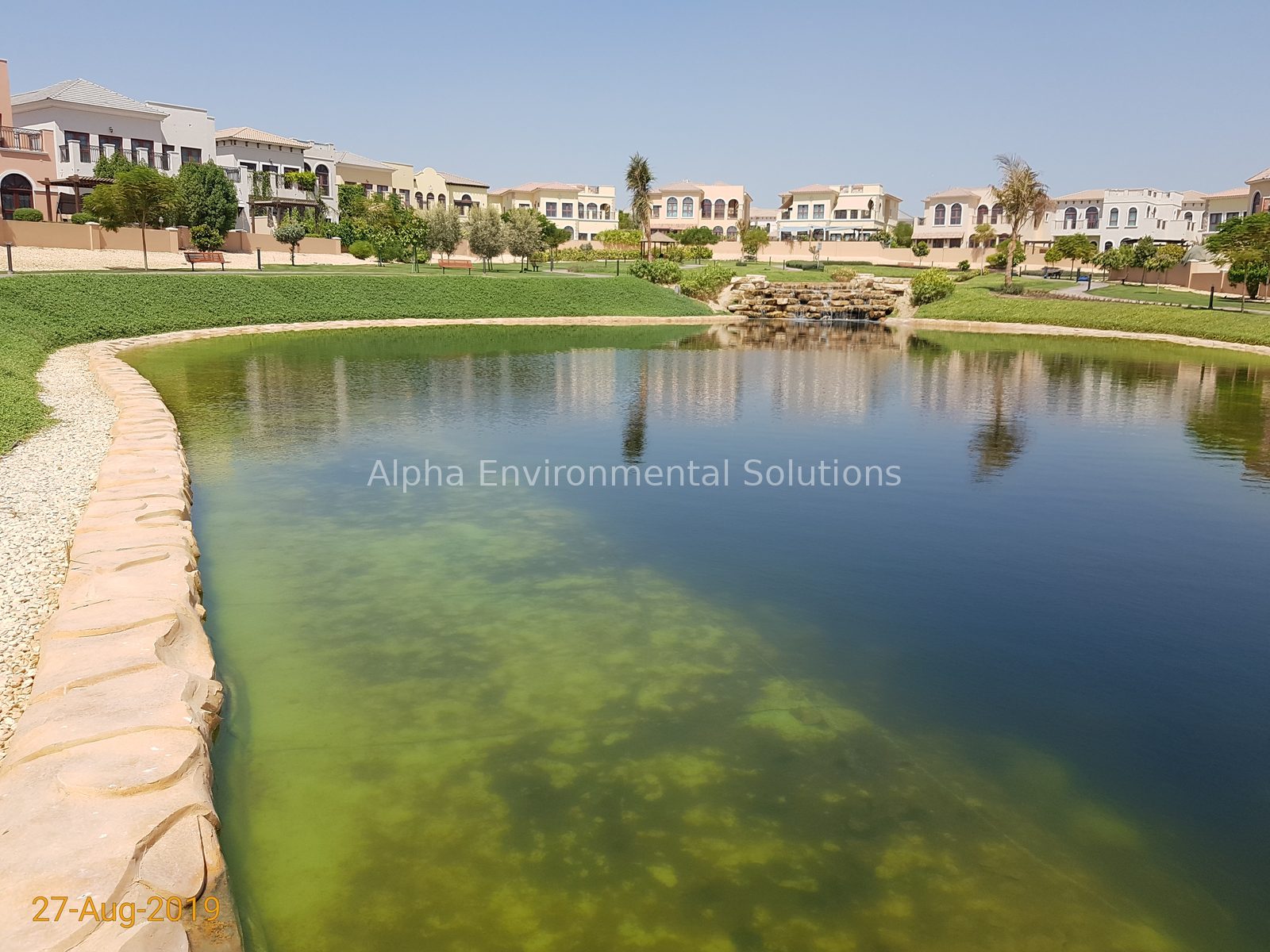
The community lake pictured below is topped up with recycled water and, by late summer, had become infested with algae, the visible result of the nutrient load this article describes.
What treated sewage effluent is, and why it fills your lake
TSE is municipal wastewater that has passed through secondary and often tertiary treatment and disinfection. Dubai Municipality alone distributes around 270 million cubic metres of recycled water each year through more than 2,200 kilometres of irrigation mains, and the emirate has committed to reuse 100% of its treated wastewater by 2030. Abu Dhabi and Sharjah carry a similar ambition under their long standing environment strategy. For a developer or a community association, TSE is the obvious way to hold a lake at its design level through a summer that can evaporate more than a centimetre of water a day. The water is cheap, plentiful and delivered to the door. The decision to use it is not the problem. The problem is what happens when water designed to grow grass is asked to sit still in an ornamental lake.
The hidden nutrient load
Treatment plants are built to remove pathogens, solids and oxygen demanding organic matter. UAE and Dubai requirements place strong emphasis on the microbiological quality of treated sewage effluent used for irrigation. The applicable requirements depend on the intended reuse category and specify microbiological limits rather than simply requiring ‘no detectable E. coli. Nutrient removal is a separate process. Nitrogen and phosphorus are only stripped to low levels where a plant is specifically designed and operated to do so, and even good tertiary effluent commonly leaves the works carrying measurable nitrogen and phosphorus. On a lawn that residual load is a benefit, because it feeds the turf and cuts the need for added fertiliser. In a lake it becomes a liability, because there is nowhere for the nutrients to go. Every top up adds more, evaporation removes only the water and leaves the salts and nutrients behind, and the concentration climbs through the season.
What the nutrients do once the water stops moving
Phosphorus is usually the limiting nutrient in fresh water, so even a small residual can trigger a visible response. Warm, sunlit, nutrient rich, slow moving water is close to the ideal growing medium for algae. You see it first as a green tinge, then as pea soup turbidity, then as the floating mats and scums that gather against the downwind shore. Some of that growth is blue green algae, or cyanobacteria, which can release toxins that put children and pets at risk. Submerged weed thrives on the same nutrients and blocks pumps and intakes. When each bloom dies it sinks and rots, and that decay strips oxygen from the water and builds a black, sulphurous layer of sludge on the bed. The familiar sequence of green water, bad odour and dead fish follows, and recycled water top ups keep resupplying the fuel. We describe the visible end of this in our note on why UAE community lakes turn green.
Why the Middle East climate makes it worse
The regional climate sharpens every step. Water temperatures above 30 degrees speed up algal growth and cut how much oxygen the water can hold. High evaporation concentrates nutrients and salts faster than in a temperate lake, so salinity and nutrient levels can both drift upward across a single summer, a pattern we cover in our note on falling lake levels and rising salinity. Many UAE amenity water bodies are also closed lagoons with little or no natural flushing, so whatever enters tends to stay. That combination, a steady nutrient supply, high heat and no outlet, is why an untended recycled water lake in the Gulf can turn from clear to green in weeks rather than seasons.
How to manage a recycled water lake
Managing a TSE fed lake is not about giving up recycled water. It is about controlling what the nutrients are allowed to do once they arrive. A practical programme covers the following.
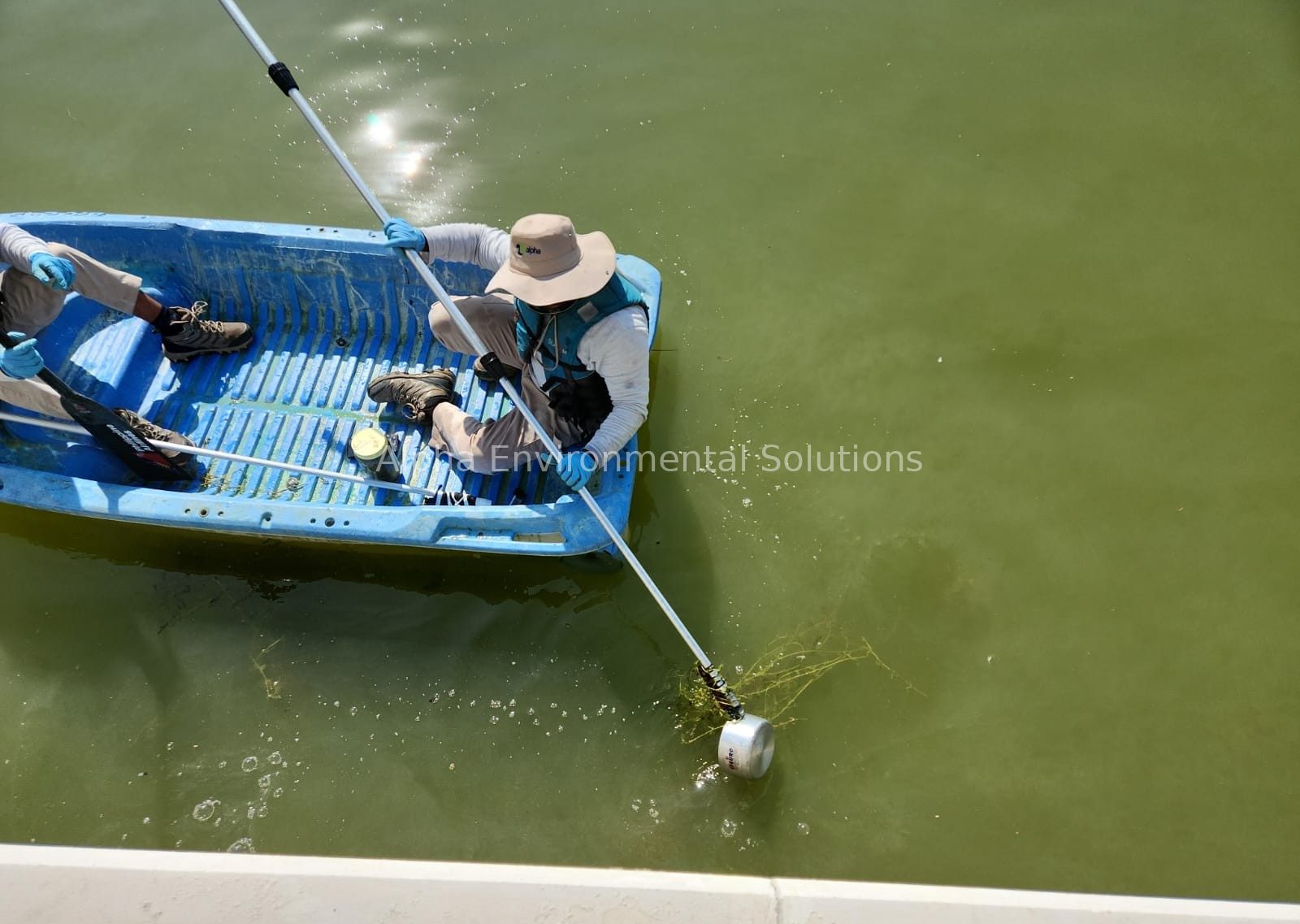
- Baseline and monitoring: test the incoming TSE and the lake itself for nutrients, salinity, dissolved oxygen and algae, so decisions rest on data rather than guesswork.
- Aeration and circulation: keep the water moving and oxygenated with bottom diffused aeration or fountains, which suppress the oxygen starved conditions that release sediment bound phosphorus and cause odour.
- Nutrient control: apply targeted treatments and, where suitable, phosphorus binding products to lock up the nutrient that drives blooms.
- Sludge management: profile and remove the organic sludge layer before it becomes an internal nutrient store that feeds algae even without fresh top ups.
- Weed and algae control: remove growth mechanically and biologically before it dies back and adds to the sludge.
- Top up discipline: match inflow to genuine losses, avoid overfilling, and where possible manage or blend the source to limit the nutrient dose.
A managed lake draws on several of these at once. Alpha’s field teams combine lake management, aeration systems, sludge removal and lake weed control, backed by environmental consultancy, so the water body is treated as one system rather than a set of separate call outs.
What UAE regulators expect
Water quality in amenity lakes is not only an aesthetic matter. In Dubai, closed water bodies fall under environmental oversight, and operators are expected to monitor and maintain defined water quality parameters, a subject we set out in our guide to lake water quality monitoring and DECCA. A lake that is allowed to decline can breach those expectations, create a public health concern through cyanobacteria or mosquito breeding, and expose the developer or managing agent to enforcement and reputational risk. Treating recycled water as a managed input, rather than a free refill, is the difference between a compliant water feature and a standing liability.
Frequently asked questions
Is it safe to fill a community lake with TSE?
Yes, provided the water meets the relevant reuse standard and the lake is actively managed. TSE is treated and disinfected to a defined quality and is widely and legitimately used across the UAE. The caution is about the nutrients it carries, which need active management once the water sits in a standing lake.
Why does my lake keep turning green even though the water is treated?
Because treatment targets pathogens and organic matter, not the low levels of nitrogen and phosphorus that still feed algae. In a warm, closed lake those residual nutrients build up with every top up and drive repeated blooms.
Does topping up with recycled water make salinity worse?
It can. Evaporation removes pure water and leaves salts behind, and each TSE top up adds a little more salt. Across a hot season salinity can climb noticeably, which stresses fish and plants.
Can aeration fix a nutrient problem on its own?
Aeration is essential but not a complete answer. It keeps oxygen up, discourages odour and helps stop sediment from releasing phosphorus, yet it does not remove the nutrient load. It works best as part of a programme that also addresses sludge, weed and the nutrients themselves.
How often should a recycled water lake be checked?
For most amenity lakes, routine monitoring at least monthly through the cooler months, and more often in summer, allows problems to be caught early. Continuous or frequent summer sampling is prudent for larger or high profile water bodies, and after any visible change in colour, clarity or odour.
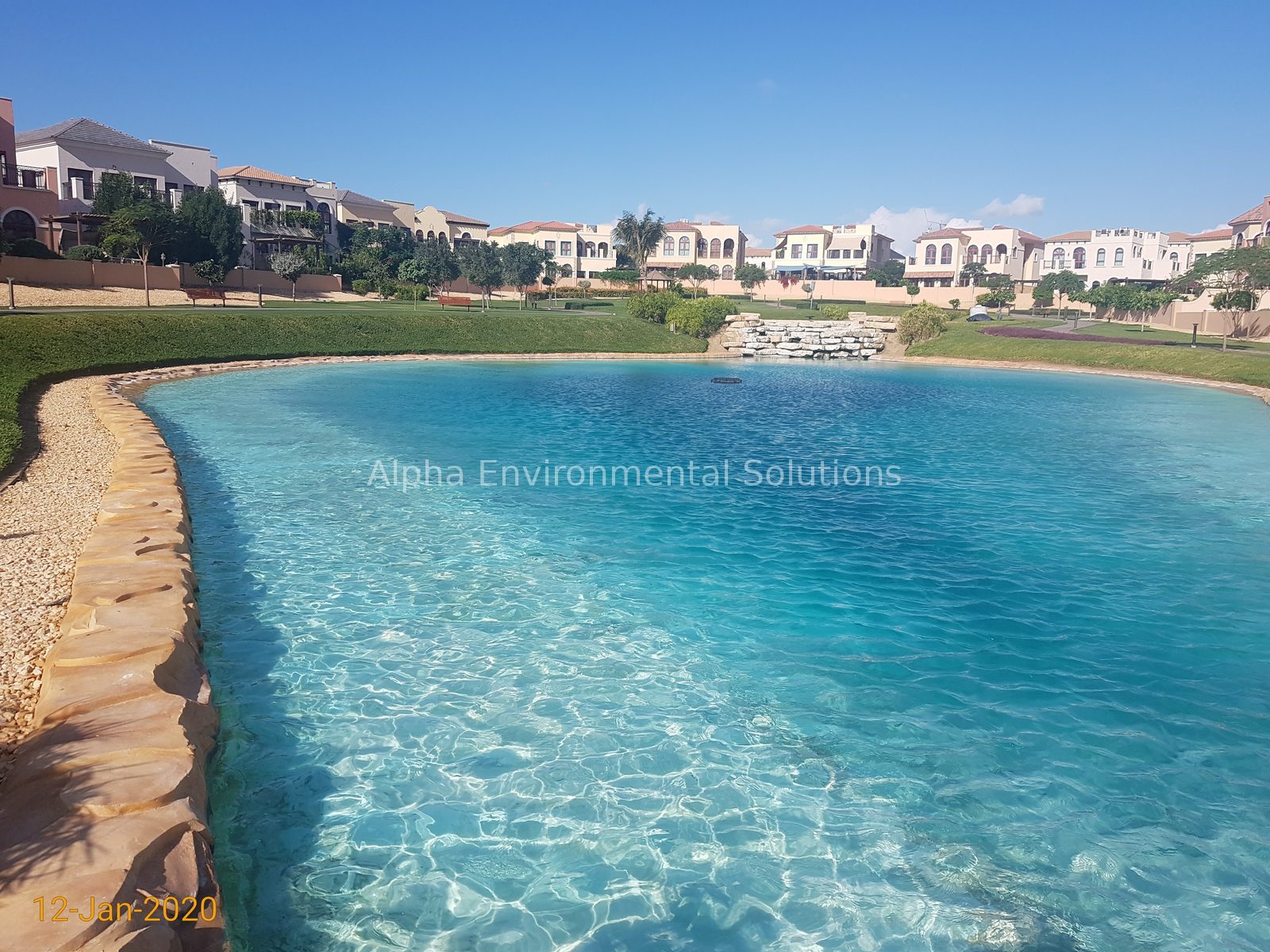
The image below shows the same community lake after Alpha implemented an annual lake management plan, with water clarity restored.
Conclusion
Recycled water is here to stay, and for a country as water scarce as the UAE that is a good thing. The mistake is to treat a TSE fed lake as maintenance free because the water arrives clean. It arrives treated and disinfected to the applicable reuse-quality requirements, but may still contain residual nutrients that, left alone, turn an amenity into a problem. With monitoring, aeration, sludge control and nutrient control in place, a recycled water lake can stay clear, safe and compliant all year. Alpha Environmental Solutions has managed lakes and lagoons across the UAE since 2007 and can assess your water body, test your source water and build a programme around it. Call +971 4 338 6660, email info@alphasolutions.ae, or visit our contact page to arrange a site visit.