
Lake sludge profiling is a survey that maps how much sludge has settled on the bottom of a lake and where it lies deepest. For the irrigation lakes that feed landscaping across so many UAE communities, that measurement matters more than it first appears. Sludge does not only affect water quality; it takes up volume, and every centimetre of it is water the lake can no longer hold. A profiling survey turns a hidden problem into clear numbers, so a developer or facilities manager can decide when cleaning is actually needed and how much, rather than guessing. Carried out ahead of the hottest months, it protects the water supply your turf and landscape depend on when demand is at its highest.
What is lake sludge profiling?
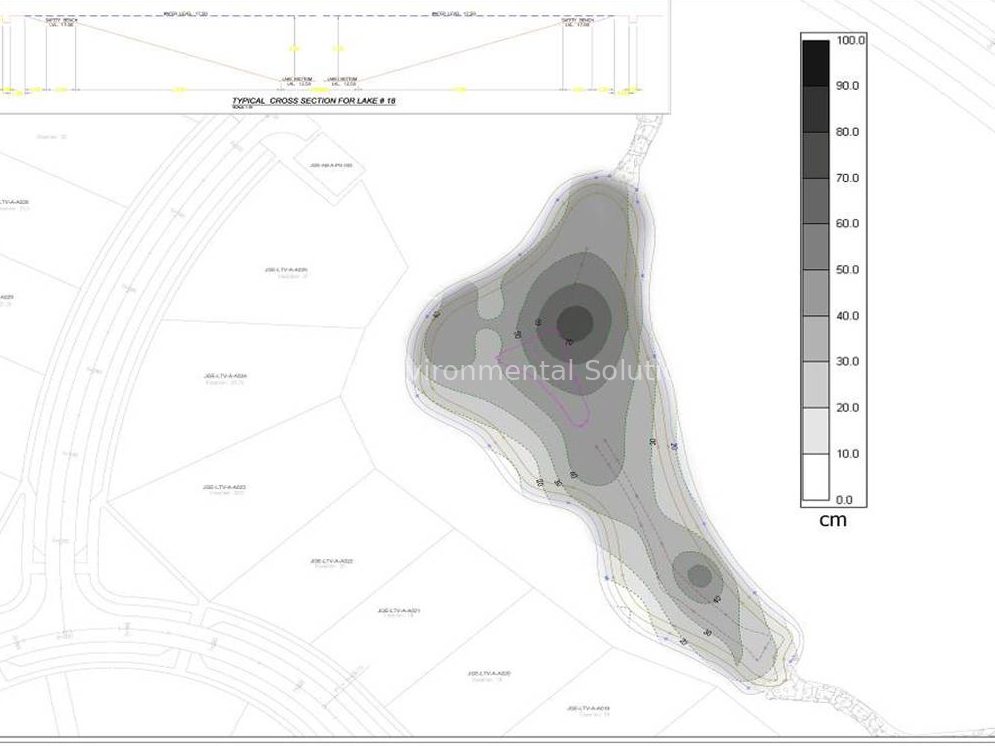
Lake sludge profiling, also called a sludge bathymetric survey, measures the thickness of the soft sediment layer across the whole bed of a lake. A survey team records the water depth and the sludge depth at many points, fixes each point with GPS, and combines the readings into a contour map and a volume figure. The result shows not only how much sludge is present, but exactly where it has collected, which is rarely uniform. On the map, the deep pockets stand out clearly from the shallow margins. That spatial picture is what separates a proper survey from a single spot check, and it is what turns targeted cleaning into a plan rather than a guess.
Why does sludge quietly reduce an irrigation lake’s water capacity?
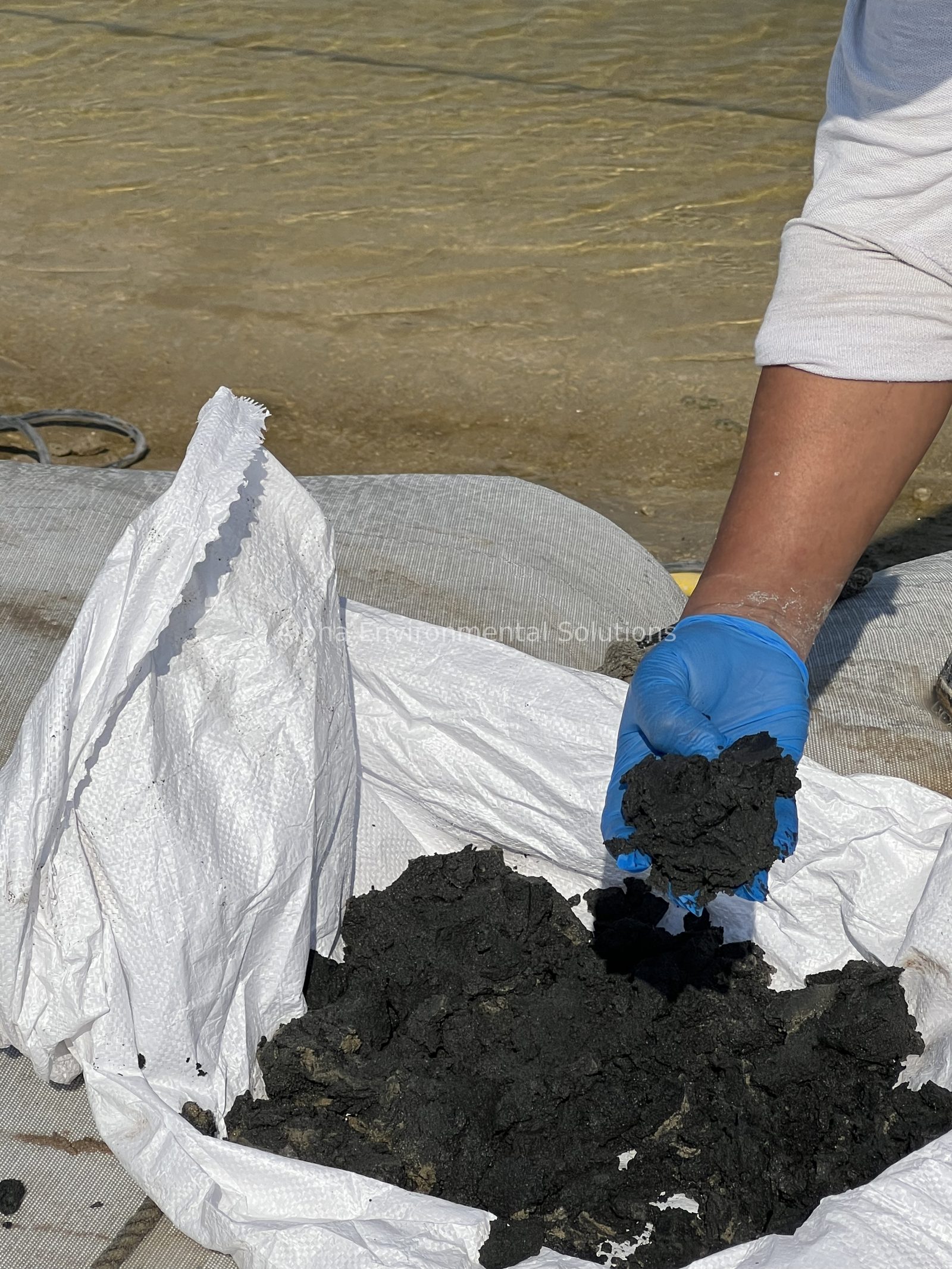
Every lake slowly fills from the bottom up. Organic matter, wind-blown dust, dead algae, grass clippings and fine soil settle out and build a layer of sludge that thickens year after year. In a decorative lake this mainly threatens water quality. In an irrigation lake it does something more direct: it steals storage. The volume taken up by sludge is volume that can no longer hold irrigation water.
The loss is easy to underestimate because it is invisible from the bank. Studies of reservoir sedimentation have measured storage losses in the range of roughly 7 to 20 percent from sediment build-up, and older water bodies can lose more. A UAE irrigation lake that has never been surveyed may be carrying years of accumulation and holding far less than its design volume. The danger becomes real in summer, when evaporation runs high and landscape demand peaks: a lake that has quietly lost a large share of its capacity can run short exactly when the turf needs it most.
What are the warning signs your lake needs a survey?
Some lakes announce the problem; many do not. It is worth arranging a survey if any of the following apply:
- The lake has never been profiled, or not in the last few years.
- Water levels fall faster in summer than they used to, or the irrigation system struggles to keep up.
- Recurring algae blooms, odour or fish stress, which often sit on top of a thick, nutrient-rich sludge layer.
- Visible shallowing near inlets, fountains or the edges.
- A contractor has quoted for dredging with no measured basis for the volume.
The last point matters most. Without a survey, sludge removal is priced on assumption. A profile gives everyone a measured number to work from, which protects the budget as much as the lake.
How is a sludge bathymetric survey carried out?
A professional survey is methodical rather than complicated. The core steps are:
- Grid the lake. Survey lines are planned across the water so readings cover the whole bed, not just a few points.
- Measure at each point. In deeper water a precision echo sounder records the bed profile; in shallow water a graduated sounding pole is pushed through the soft sludge to firm ground, capturing both water depth and sludge thickness.
- Fix positions with GPS. Every reading is tied to a coordinate so the data can be mapped accurately.
- Build the model. The readings become a sludge depth contour map, a cross-section, and a calculated sludge volume.
- Estimate the rate. Comparing against design levels or an earlier survey shows how fast sludge is accumulating and roughly when the lake will need attention.
The output is the kind of map shown above: an at-a-glance picture of where the sludge sits and how deep it runs.

How does profiling turn into a cleaning plan?
A survey is only useful if it drives a decision, and this is where profiling earns its place. With a measured volume and a map, cleaning can be planned instead of guessed. The team knows how much material must come out, which areas to prioritise, and therefore what the job should cost and how long it should take. Disposal can be arranged properly, because the quantity is known in advance. Just as importantly, a survey can show that a lake does not yet need full dredging, saving money on work that is not required. Our environmental consultancy team treats the survey as the first step of any sludge programme, feeding straight into a costed sludge removal plan rather than a blanket quote.
Why time the survey around peak summer demand?
In the UAE, timing is part of the value. Landscape irrigation demand climbs through the hottest months while evaporation pulls the level down, so any loss of capacity bites hardest in summer. A lake surveyed before or early in the season gives the site time to act: to plan and budget cleaning, book the work, and protect the water supply before a shortfall threatens the turf and planting. Leaving the survey until a lake visibly struggles removes that lead time and forces reactive, costlier decisions. Regular profiling, repeated every year or two, keeps the picture current and makes capacity planning routine rather than an emergency. It also informs wider lake management and aeration decisions, since a thick sludge layer drives much of the oxygen demand and nutrient release behind poor water quality.
Frequently asked questions
What is the difference between sludge profiling and sludge removal?
Profiling measures and maps the sludge; removal takes it out. Profiling comes first: it tells you how much sludge there is and where, so removal can be scoped, priced and scheduled accurately instead of estimated.
How often should an irrigation lake be profiled?
Every one to two years suits most UAE irrigation lakes, and sooner if the lake is old, heavily used, or has never been surveyed. Regular profiling tracks the accumulation rate and flags when cleaning is due before capacity becomes a problem.
Does profiling disrupt the lake or the community?
No. The survey is carried out quietly from a small boat over a day or two, with no draining and no heavy machinery. It does not interrupt irrigation or amenity use.
Can a survey really predict when the lake will run short?
It can give a well-founded estimate. By comparing current sludge volume with design capacity and the measured accumulation rate, a survey projects how storage is trending, which is far more reliable than waiting for the level to fall.
We already see algae and odour. Do we still need a survey?
Yes. Those symptoms often sit on top of a thick sludge layer, and a survey quantifies it so the underlying cause can be dealt with properly rather than treated only at the surface.
Sludge is the slow, silent tax on an irrigation lake: unseen from the bank, yet steadily eating into the water your landscape relies on. A profiling survey replaces guesswork with measured numbers, protects summer supply, and makes cleaning a planned investment rather than an emergency. Alpha Environmental Solutions has surveyed and managed lakes across the UAE and wider Middle East since 2007. To arrange a sludge profiling survey or a full lake assessment, contact our team, call +971 4 338 6660, or email info@alphasolutions.ae.