
A community lake in the Middle East can lose a surprising amount of water every day, and most operators only notice when the top-up bill rises or the edges start to show. The main routes are evaporation, seepage through a damaged liner or bank, fountain spray drift and avoidable overflow. A simple water balance, checked monthly, tells you which of these is driving the loss and whether you have a leak. With the UAE hosting the 2026 UN Water Conference in Abu Dhabi from 8 to 10 December, water use by ornamental lakes and lagoons is likely to face closer questions from owners’ associations, master developers and regulators. This guide explains how community lake water loss happens, how to measure it and what to fix first.
Why is community lake water loss under the spotlight?
The UAE and Senegal co-host the UN Water Conference at ADNEC in Abu Dhabi from 8 to 10 December 2026. According to the UAE Ministry of Foreign Affairs, it is the first UN conference dedicated to speeding up delivery of Sustainable Development Goal 6 on water and sanitation. At national level, the UAE Water Security Strategy 2036 sets targets that include cutting total demand for water resources by 21 per cent, halving average consumption per person and reusing 95 per cent of treated water. Lakes and lagoons in residential communities, parks, hotels and golf courses are highly visible water users, and most are topped up with desalinated water or treated sewage effluent (TSE) that somebody pays for.
The same pressure applies across the Gulf and the wider Middle East, where rainfall is scarce and supply leans heavily on desalination. A lake that leaks or wastes water is no longer just a line in the maintenance budget. It is a reputational risk for the developer or facilities manager responsible for it, and often an early sign that the asset itself is deteriorating out of sight.
Where does the water go?
Every lake has a water balance. What goes in (top-up, rainfall and runoff) must equal what goes out (evaporation, seepage, abstraction and overflow) plus any change in level. When the numbers do not add up, the gap is the loss you have not yet explained. In our fieldwork on UAE community lakes since 2007, five routes account for most of it:
- Evaporation: the largest and least avoidable loss in a hot, dry and often windy climate.
- Seepage and leakage: water escaping through a torn geomembrane liner, failed seals around inlets and outlets, or porous banks.
- Fountain and spray drift: fine droplets blown off high decorative jets, which rises sharply on windy days.
- Irrigation abstraction: lakes that double as irrigation reservoirs, where draw-off is often unmetered or poorly recorded.
- Overflow and control faults: float valves and level sensors that stick open and send top-up water straight to the overflow.
The order of importance changes from site to site. A shallow, wide lake exposed to the prevailing wind loses more to evaporation, while an older lake with a patched liner may lose more through its floor than to the sky.
How much water can a lake lose to evaporation?
The climate does most of the damage. Fanack Water gives an average daily evaporation figure of 8.2 mm for the UAE, against average rainfall of only 78 mm a year. If that daily average held all year, it would remove roughly three metres of water depth, many times what rain puts back. Rates are higher in summer than in winter, so losses peak exactly when lakes are most exposed to algae blooms and low oxygen.
In practical terms, a lake with a surface area of 10,000 square metres losing 8 mm a day gives up about 80 cubic metres of water daily, or close to 29,000 cubic metres over a year, before a single leak is counted. Research from Loughborough University, reported by The National, estimated that swimming pools on Palm Jumeirah alone lose around 603 million litres a year to evaporation, which shows how quickly open water adds up in this climate. Pools can be covered; lakes cannot, so managing evaporation is about reducing exposure rather than stopping it.
How do you tell evaporation from a leak?
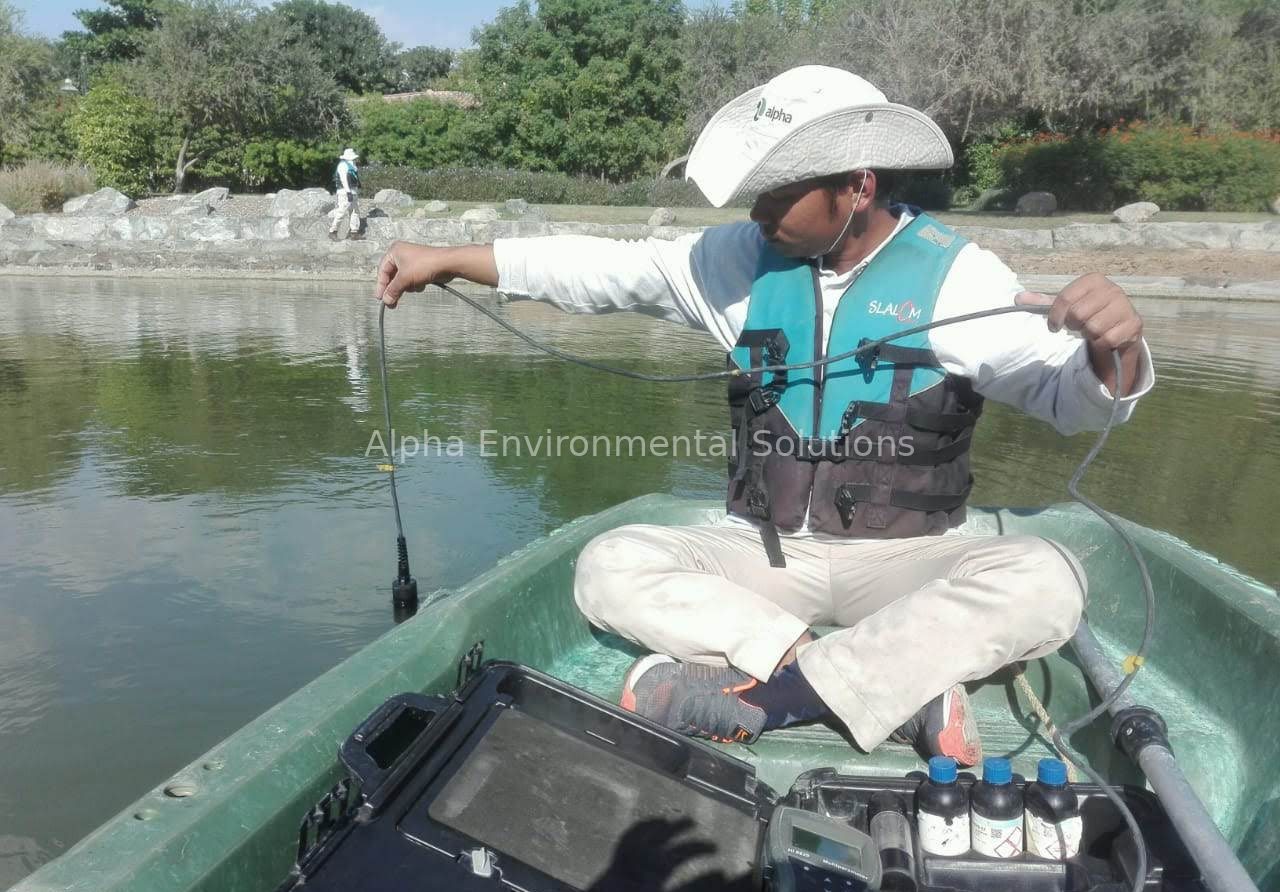
The quickest field check is the bucket test, a method long used for pools and ponds. A bucket of lake water is set on a step or platform in the lake so that it shares the same temperature and exposure, and the water level is marked inside the bucket and on the lake edge. Top-up is switched off for 24 to 72 hours and the two drops are compared. If the lake falls noticeably faster than the bucket, the extra loss is going somewhere other than the air. Running the test a second time with fountains switched off separates spray drift from seepage.
A monthly water balance is the more reliable long-term tool. It needs a fixed level gauge or logger, a working meter on the top-up line, a record of irrigation draw-off and a local evaporation estimate. Once those are in place, a rising unexplained loss stands out within weeks. Our environmental consultancy team builds these balances for lakes where records are missing or the meters have never been checked.
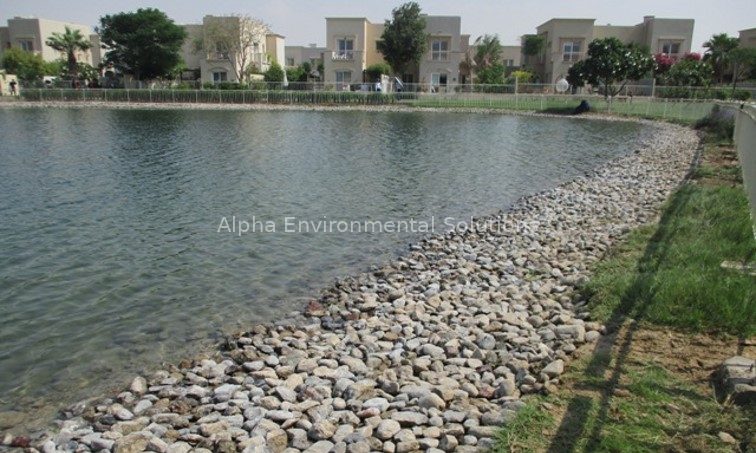
Field signs of leakage include wet or soft ground beyond the lake edge, grass or weeds that stay unusually green on the outside of a bank, settlement or cracking in paving near the water, and liner material lifting or exposed at the shoreline. Where a leak is suspected, dye testing at inlets, outlets and joints can confirm the path, and electrical leak location surveys can pinpoint holes in a geomembrane liner without draining the lake.
Why is water loss also a water quality problem?
Losing water changes what is left behind. Evaporation removes fresh water but leaves salts in the lake, so conductivity and salinity climb through the summer. We covered this in our article on why community lake levels drop in summer and what rising salinity does. Larger top-up volumes then bring in more of whatever the make-up water carries. Where that is TSE, every extra cubic metre adds nitrogen and phosphorus that feed algae, as explained in our post on recycled water and the nutrient load it brings.
Leaks cause damage of their own. Water escaping through a bank can wash out fine material, undermine stone edging and paving, and in the worst cases threaten nearby landscaping, walkways or structures. Shallow margins left by a falling level warm quickly, favour rooted weeds and filamentous algae, and can expose sludge that releases odour. A lake that is constantly being refilled is rarely a stable lake.
What can owners and facilities managers do now?
Start with measurement. Repair or install the top-up meter, add a level logger and record irrigation draw-off. Without these numbers every other decision is guesswork, and the case for capital repairs is hard to put to an owners’ association or a board.
Next, deal with the avoidable losses. Repair sticking float valves and recalibrate level controls so top-up water does not run straight to the overflow. Review fountain programmes: tall decorative jets lose water to wind drift, and in many lakes oxygen can be delivered more efficiently by subsurface diffused aeration systems, which add very little to surface loss. Windbreak planting on exposed sides and avoiding unnecessary shallow fringes also cut evaporation at the margins.
Where the balance points to seepage, plan the repair before summer. Liner patches, re-sealing of pipe penetrations and rebuilding failed banks with properly designed lake shore embankment protection are easier in the cooler months. If sludge removal is already due, combining it with a liner inspection avoids opening the lake twice. Budget for this in the next service charge cycle; our guide to lake maintenance budgets lists what to include.
How does Alpha Environmental Solutions approach lake water loss?
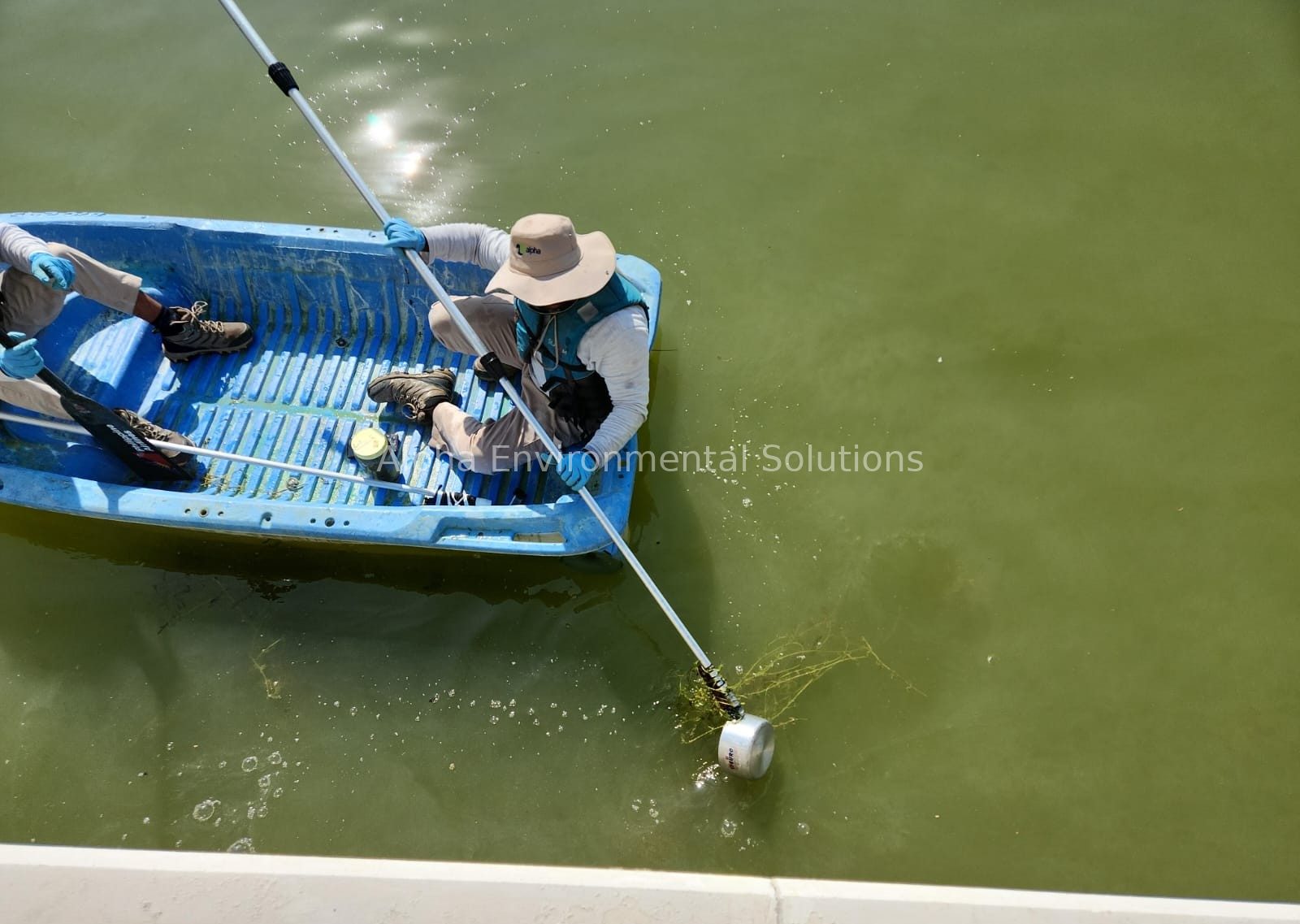
Alpha Environmental Solutions has managed lakes, lagoons and water features across the UAE and the wider Middle East since 2007. On water loss, our work typically combines a site inspection of banks, liners and inlets; level and conductivity monitoring; a review of top-up, irrigation and fountain records; and a water balance that separates evaporation from leakage. From there we recommend the repairs and operating changes that recover the most water for the money, and fold them into a lake management programme so the gains last.
We keep water quality in view throughout. Any change to the top-up source, fountain operation or aeration affects dissolved oxygen, nutrients and salinity, so each recommendation is checked against the water quality targets the lake has to meet, including the lagoon limits in Dubai Municipality’s environmental clearance guidance where they apply.
Frequently asked questions
How much water does a community lake lose to evaporation in the UAE?
Fanack Water reports average daily evaporation of about 8.2 mm in the UAE. For a lake of 10,000 square metres, that equals roughly 80 cubic metres a day before any leakage is counted, with higher losses in summer.
How can I tell whether my lake is leaking?
Compare the lake’s level drop with a bucket of lake water over 24 to 72 hours with top-up switched off. If the lake falls faster than the bucket, the difference is likely leakage. Wet ground outside the bank and rising top-up volumes are further warning signs.
Do fountains increase lake water loss?
Yes. Tall decorative jets lose water as wind-blown spray, especially on windy days. Subsurface diffused aeration can often supply the oxygen a lake needs with far less surface loss.
Does water loss affect lake water quality?
Yes. Evaporation concentrates salts, and larger top-up volumes bring in more nutrients when the make-up water is TSE, which can feed algae blooms.
When is the best time to repair a leaking lake?
The cooler months, typically November to March across the Gulf, are the most practical time, because works are easier and the lake is less stressed before the summer peak.
Act before the summer peak
Community lake water loss is driven by a hot, dry climate that nobody can change, but a large share of it is avoidable. Unmetered top-up, faulty controls, spray drift and slow leaks waste water and money, and they push water quality in the wrong direction. With national water targets tightening and the UN Water Conference putting the region’s water use in front of a global audience, now is the time to measure your lake’s water balance and fix what can be fixed before next summer.
To arrange a water loss assessment for a lake, lagoon or water feature anywhere in the UAE or the wider Middle East, contact Alpha Environmental Solutions on +971 4 338 6660, email info@alphasolutions.ae, or send an enquiry through our contact page.