
A community lake is a magnet for ducks, geese, herons, coots and gulls, and every bird that feeds and rests on the water leaves droppings behind. Those droppings are rich in nitrogen and phosphorus, and in a closed amenity lake they behave like a slow dose of fertiliser: they feed algae, strip oxygen from the water, cloud the surface and raise real health concerns. The pressure builds through autumn and winter, when migratory waterfowl arrive across the Gulf and the wider Middle East to join the resident birds. The practical answer is not to fight the birds, which are protected, but to manage the water body and its shoreline so the extra nutrient load does not tip the lake into a green, low-oxygen state. That means buffer planting, aeration, nutrient and algae control, regular testing, and a firm no-feeding policy.

Why waterfowl gather on Middle East community lakes
Ornamental and amenity lakes offer birds exactly what they want: open water for safety, mown lawns for grazing, and a steady supply of food from residents who enjoy feeding them. The region’s mild winters make it more attractive still. Autumn and winter, roughly September through February, are the peak migration seasons, when large numbers of ducks, teal, shovelers, waders and other waterbirds move south into the Gulf and settle on any suitable water. Mid-winter counts at protected UAE wetlands have exceeded 10,000 waterfowl, and while a single community lake holds a fraction of that, even a modest resident flock concentrated on a small water body adds up quickly.
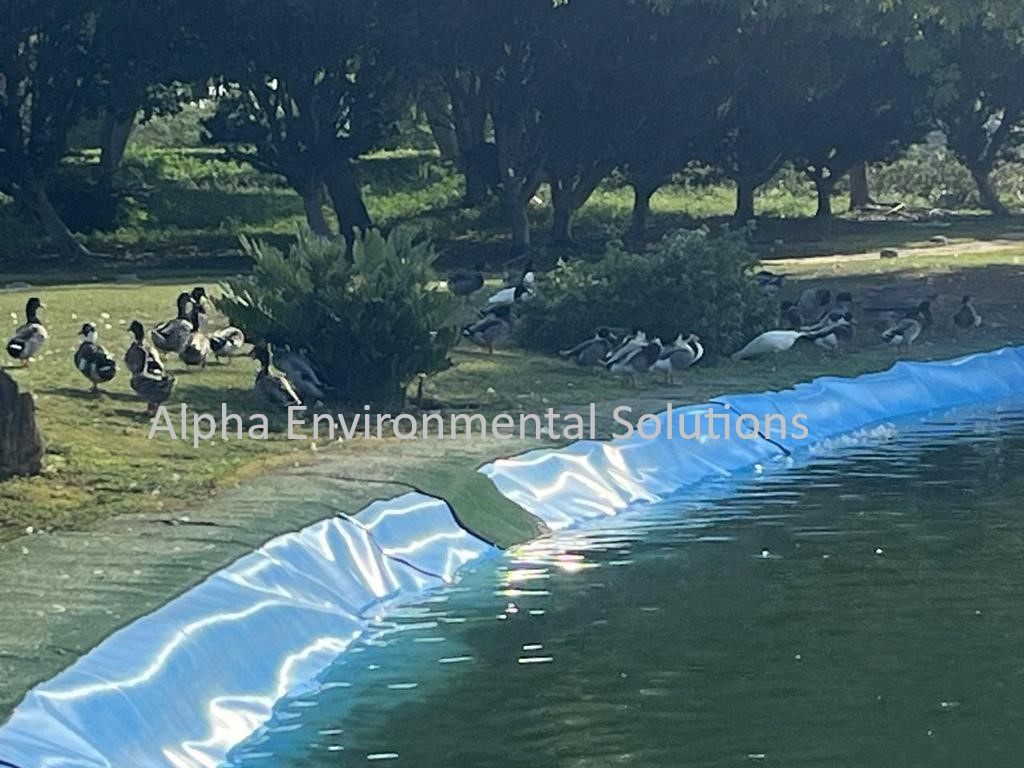
The design of most community lakes makes the problem worse. Manicured turf running straight to the water’s edge, with clear sightlines and no tall planting, is close to ideal habitat for geese and ducks, which prefer open ground where predators cannot hide. Add regular feeding by residents, and a lake that could support a handful of birds ends up hosting a permanent, well-fed flock that never really moves on.
What bird droppings do to lake water
The issue is not the birds themselves but what they deposit. A single goose can produce roughly 0.5 to 0.9 kg of droppings a day, loaded with nitrogen and phosphorus. In a lake with limited flushing, those nutrients accumulate rather than wash away. Phosphorus in particular is the nutrient that usually limits algal growth, so adding more of it is like turning up a dial: the water responds with blooms of green algae and, in warmer conditions, blue-green algae. As blooms thicken they block light, and when they die and decompose they consume oxygen, which is how a nutrient problem becomes a fish-kill problem.
There is a public-health dimension too. Waterfowl droppings carry bacteria such as E. coli and Salmonella, which can contaminate the water and the surrounding paths and lawns. For a lake bordered by walkways, play areas and cafes, that is a reputational and safety concern as much as an ecological one. The nutrient load also settles over time as organic sediment on the bed, which stores phosphorus and feeds the cycle in following seasons, so the effect of a large flock is cumulative, not a one-off.
The warning signs communities should watch for
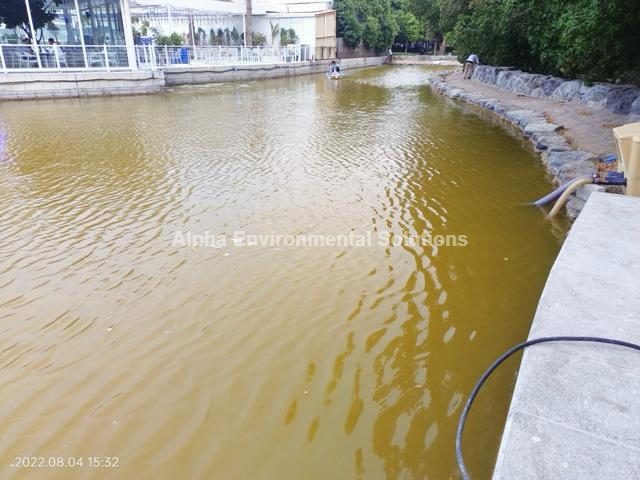
The early signs are easy to miss until the lake looks and smells wrong. Water that turns green or cloudy, a surface scum near the downwind bank, a musty or rotten-egg odour, and dead fish or birds at the edge are all pointing at the same underlying cause: too many nutrients and too little oxygen. Heavy fouling of the paths and grass around the lake, and a flock that has clearly grown over a season or two, are the visible symptoms of the nutrient source itself. Left unmanaged, the lake moves from an occasional bloom to a chronic green state that is far harder and more expensive to reverse.
How to manage waterfowl nutrient loading
Because the birds are protected and the load is continuous, the durable fix works on the habitat and the water body rather than on the birds. In practice a combination of measures works best:
- Introduce a clear no-feeding policy, with signage, so residents stop concentrating and sustaining the flock.
- Plant vegetated shoreline buffers: a strip of taller native planting at the water’s edge breaks the open-lawn sightline birds prefer, and intercepts nutrient-rich runoff before it reaches the water.
- Keep the water moving with aeration and circulation, which lifts dissolved oxygen and makes blooms and stagnation less likely.
- Manage nutrients and algae directly, and remove accumulated sludge that stores phosphorus on the bed.
- Test the water regularly for nutrients, oxygen and clarity, so a rising load is caught before it becomes a bloom.
- Reduce the area of mown turf running to the edge, and avoid over-fertilising adjacent lawns, which adds to the same nutrient pool.
No single step solves it. Buffer planting and a no-feeding policy reduce the load reaching the water, while aeration, algae management and sediment removal raise the lake’s capacity to absorb what still gets in. It is worth stressing that wild and migratory birds are legally protected in the UAE and across much of the Middle East, so lethal or harmful deterrence is not an option: the goal is to make the lake less attractive as a permanent feeding ground and more resilient to the nutrients it receives. This is where a survey through environmental consultancy pays off, because it identifies whether birds, recycled-water top-ups, adjacent lawns or legacy sediment are the dominant nutrient source, so effort is spent where it counts.
How Alpha Environmental Solutions helps
Alpha Environmental Solutions has managed community and amenity lakes across the UAE and the wider Middle East since 2007, and nutrient loading from waterfowl is a familiar part of that work. We treat it as a whole-lake issue: testing the water to confirm the nutrient source, installing and maintaining aeration systems to protect oxygen, controlling algae and removing the nutrient-rich sludge that stores phosphorus on the bed, and advising on vegetated shoreline buffers that both reduce bird access and intercept runoff. Because the same nutrients drive the green water and, at worst, the toxic blue-green algae that put people and pets at risk, addressing the bird load is part of a broader lake management and pest management plan rather than a standalone job.
Act before the winter flock settles in
Waterfowl numbers on community lakes rise through autumn and peak in winter, so the sensible time to act is before a large flock becomes established and the water turns. Assessing the lake now, confirming the nutrient source and putting buffer planting, aeration and a no-feeding policy in place is far cheaper than reversing a chronic bloom later. If you manage a community lake, lagoon or amenity water body anywhere in the UAE or the wider Middle East, Alpha Environmental Solutions can test the water, identify the real nutrient drivers and build a management plan that keeps it clear. Call +971 4 338 6660, email info@alphasolutions.ae, or visit our contact page to arrange a site assessment.
Frequently asked questions
Do birds really cause algae in a community lake?
Yes, indirectly but significantly. Bird droppings are rich in nitrogen and phosphorus, and phosphorus is usually the nutrient that limits algal growth in a lake. A large, well-fed flock adds a continuous supply of it, which feeds green algae and, in warm water, blue-green algae. In a closed amenity lake with little flushing, that load builds up rather than washing away, so waterfowl are often a major driver of persistent green water.
Why is the problem worse in autumn and winter in the Middle East?
Autumn and winter, roughly September to February, are the peak migration seasons, when large numbers of ducks and other waterbirds move south into the Gulf to escape colder regions. They join the resident birds on any suitable water, so the total flock on a community lake, and the nutrient load it deposits, tends to rise sharply through this period.
Can we just remove or scare the birds away?
No. Wild and migratory birds are legally protected in the UAE and across much of the region, so harming or removing them is not an option. Management focuses on making the lake less attractive as a permanent feeding ground, mainly by stopping feeding and adding shoreline planting, and on strengthening the water body with aeration and nutrient control so it copes with the birds that do visit.
Are bird droppings in a community lake a health risk?
They can be. Waterfowl droppings can carry bacteria such as E. coli and Salmonella, which may contaminate the water and the paths and lawns around it. For a lake bordered by walkways and play areas, that is a genuine safety and reputational concern, which is another reason to manage the flock size and keep the water quality under control.
What is the most effective long-term fix?
A combination. Cut the incoming load with a no-feeding policy and vegetated shoreline buffers, then raise the lake’s resilience with aeration, algae management, sediment removal and regular water testing. A survey first is what makes it efficient, because it confirms whether birds or other sources are the main problem, so the plan targets the real cause.